What Is StemWave Therapy and How Do Acoustic Waves Affect Tissue?
Saltwater Wellness
|
October 25, 2026
|
7 min read
STEMWAVE THERAPY
Table of Contents
- 1. Why Sound Waves Are Used for Pain
- 2. StemWave Therapy and the Body's Response to Pressure
- 3. Why Focused and Radial Waves Are Different
- 4. What Studies Can and Cannot Show
- 5. What FDA Listing Really Means
- 6. What Happens During a Visit?
- 7. Who Needs a Careful Safety Check?
- 8. Frequently Asked Questions
- 9. Putting the Science in Context
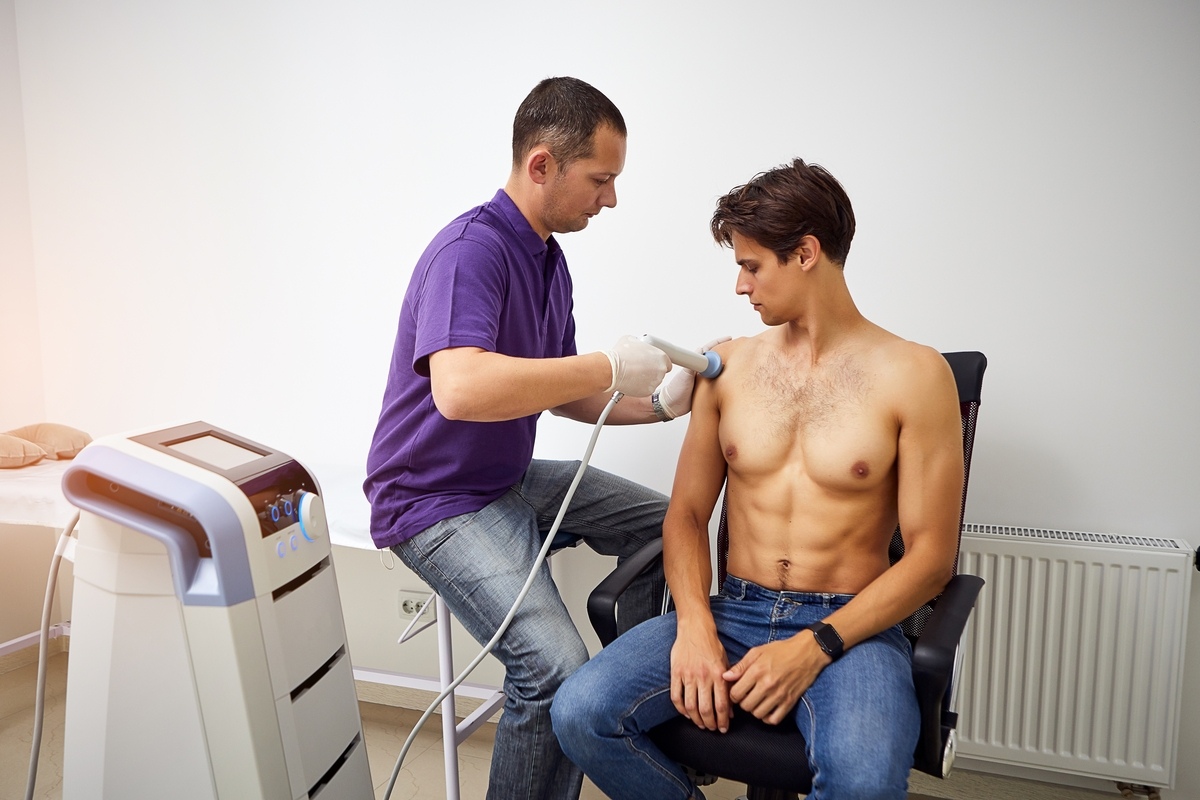
A sore shoulder can make simple movements harder. But how might sound waves affect the tissues beneath your skin?
StemWave therapy uses brief pulses of acoustic energy delivered through a handheld applicator. They create mechanical forces that tissues can sense, without stem cell injections. Saltwater Wellness includes the approach among its longevity and wellness treatments.
1. Why Sound Waves Are Used for Pain
Sound waves are shifts in pressure that travel through the body. A device sends short bursts through the skin. There is no cut or injection.
A related medical approach is extracorporeal shockwave therapy (ESWT). Extracorporeal simply means the energy comes from outside the body. Researchers have studied ESWT for tendon and heel conditions, with mixed results.
According to Mayo Clinic’s shockwave treatment overview, focused shockwaves and radial pressure waves differ in how they work. Each sends force through the skin, but they are not the same.
Noninvasive means no surgical cut. It does not mean suitable for everyone.
2. StemWave Therapy and the Body's Response to Pressure
The maker calls its system PACE. It sends short bursts of force into a chosen area. PACE is a brand name, not a medical term.
Cells can sense force and react to it. Scientists call this mechanotransduction. It also happens when we move or exercise. Researchers are testing how sound waves may affect these cell signals.
Scientists have explored these possible effects:
Cell signaling: Mechanical forces may alter messages that cells send to one another.
Local circulation: Some forms of acoustic stimulation may temporarily affect blood flow near the treated area.
Pain responses: Changes in nerve signaling may influence how discomfort is felt.
Tissue activity: Laboratory findings suggest possible effects on processes involved in repair, though results differ across studies.
These proposed effects do not prove that injured tissue will regenerate. No stem cells are added during treatment.
3. Why Focused and Radial Waves Are Different
Focused shockwaves and radial pressure waves differ. Focused waves concentrate energy at a chosen depth. Radial waves are strongest near the applicator and spread outward.
| Feature | Focused Shockwaves | Radial Pressure Waves |
|---|---|---|
| Energy pattern | Concentrates at a selected depth | Strongest near the skin, then spreads outward |
| How generated | May use electrohydraulic, electromagnetic, or piezoelectric technology | Often uses a moving projectile inside the handpiece |
| What can vary | Treatment depth, intensity, and focus | Surface pressure, intensity, and applicator type |
Piezoelectric means a material changes shape when it gets an electric signal.
StemWave describes its system as focused. That does not mean studies of other focused devices apply to it. Two treatments may share a name yet deliver very different amounts of energy. When you read a study, check which device was tested and what problem the participants had.
4. What Studies Can and Cannot Show
Researchers have examined shockwave treatments for conditions such as plantar fasciitis, which causes pain around the heel, and some long-lasting tendon problems. Some trials report less pain; others find unclear benefits.
According to a peer-reviewed review of shockwave care, studies use different waves, doses, and schedules. The authors also stress screening, an accurate diagnosis, and staff training. Research on shockwaves generally cannot prove that StemWave therapy treats every condition studied or replaces other care.
Look for a fair comparison. Some studies use a sham treatment, which looks like real care but lacks the active waves. This helps show whether people improved because of treatment or for other reasons.
5. What FDA Listing Really Means
According to StemWave’s device information, its Modus-F device is listed with the U.S. Food and Drug Administration (FDA) as a Class I therapeutic massager, a generally lower-risk device category. The maker says the device is meant to briefly ease minor muscle pain and raise local blood flow for a short time.
The manufacturer says the device is exempt from 510(k) premarket notification. FDA registration and listing do not mean the agency has approved claims that it heals injuries or grows new tissue. The stated use of StemWave therapy is much narrower than claims of stem cell activation, tissue growth, or cures for long-term injuries.
If soreness keeps returning, read about possible reasons for slow workout recovery. Persistent pain or limited movement deserves assessment.
6. What Happens During a Visit?
A provider should review your symptoms and health history first. If the cause of pain is unclear, medical assessment may be needed before treatment.
During a session, a handheld applicator touches the skin, often with gel. You may feel tapping or pressure. Tell the provider if it becomes painful.
Before a session, useful questions include:
What is being treated? Ask for a clear explanation of the problem, not just the location of pain.
How is intensity chosen? Find out how the provider adjusts treatment to your comfort.
What change would count as progress? Think about walking, reaching, or other daily activities.
What other care still matters? Exercise, rest, or physical therapy may be part of the broader plan.
Several visits may be suggested. Ask when to review progress and stop if there is no benefit. If pain stays the same, ask whether a different type of care or a new assessment is needed.
7. Who Needs a Careful Safety Check?
You might feel sore or see some redness or bruising. Other risks depend on where the waves are used and your health.
Shockwave safety guidance points to issues that need extra care:
Pregnancy: Treatment may be unsuitable, particularly near the pregnancy.
Infection or a suspected tumor near the site: These need medical assessment, not routine treatment over the area.
Bleeding disorders or blood-thinning medicines: The risk of bruising or bleeding may be higher.
Implanted devices or sensitive structures: The provider should check whether treatment near them is appropriate.
A possible fracture or major tendon injury: A clear diagnosis is needed before selecting a procedure.
These cautions come from broader shockwave research, not a device-specific checklist. Ask which precautions apply to StemWave therapy.
For general questions about an evaluation, you can contact Saltwater Wellness. Seek medical care for severe pain, new weakness, marked swelling, or symptoms following a significant injury.
8. Frequently Asked Questions
No. Acoustic pulses pass through the skin without injecting or transplanting stem cells. That does not prove tissue grows back.
It may feel like tapping or pressure, especially over a tender area. Tell the provider if discomfort is strong. Pain does not prove it works.
That outcome is not established for this device. A suspected tear needs diagnosis and appropriate care.
There is no reliable timeline for everyone. Agree on useful ways to track changes instead of expecting immediate relief.
No. The maker calls it a registered and listed Class I therapeutic massager. This is not FDA approval for new tissue growth.
9. Putting the Science in Context
Mechanical waves can affect tissue, and scientists are studying possible effects on pain and cell activity. A biological response, though, is not proof of injury repair.
If you are considering StemWave therapy, ask about your diagnosis, the evidence for your condition, and the device’s limits. Discuss realistic outcomes and how progress will be checked. You can also ask what other forms of care remain useful if symptoms continue.
Key Takeaways
Acoustic waves deliver mechanical energy. The device does not inject stem cells or other materials.
Mechanotransduction describes how cells sense force. It does not, by itself, prove that injured tissue will regenerate.
Focused and radial devices differ. Their settings and study results are not automatically interchangeable.
The manufacturer’s stated intended use is limited. FDA listing does not mean FDA approval of broad healing claims.
Diagnosis and safety come first. Persistent pain warrants assessment, and treatment decisions should consider individual risks.
Want to Learn More About Acoustic Wave Treatment?
If discomfort affects your activities, a qualified healthcare professional can discuss possible causes and care options. Saltwater Wellness can explain its evaluation process for acoustic wave services.
Disclaimer
This article is for learning, not medical advice. Results from one type of shockwave device may not apply to another. Seek care for pain that lasts or an injury that gets worse. Do not put off needed medical help.